

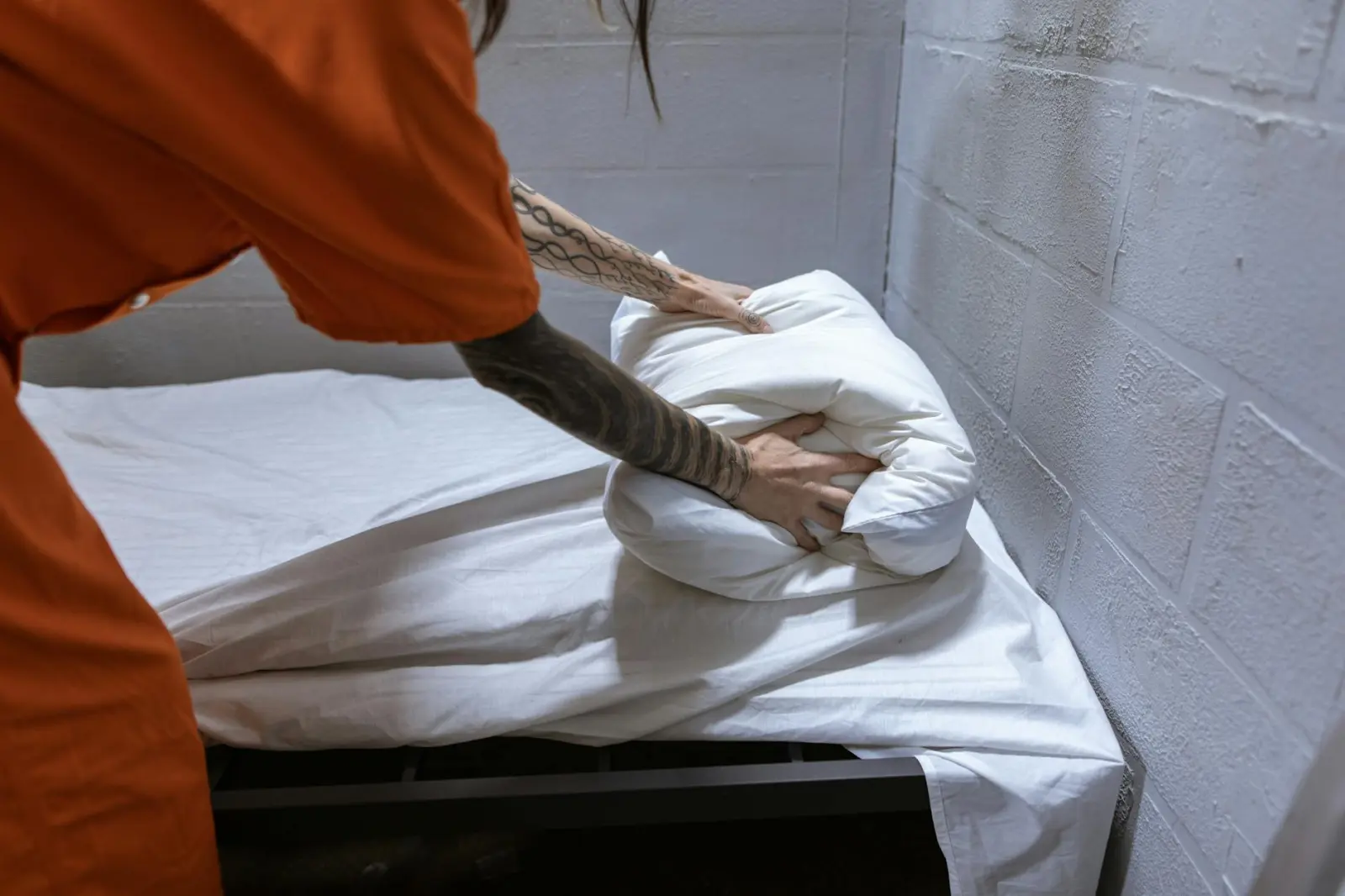
Prison doesn’t just take away freedom of movement. It often takes away the small, steadying choices that help people regulate themselves: when to be alone, when to speak, when to rest, what to eat, how to move through a day without being watched. When those ordinary freedoms disappear, the mind tends to react in ordinary human ways – tension, irritability, numbness, hypervigilance, or a heavy sense that nothing is really yours.
A lot of people describe prison as loud and lonely at the same time. You can be surrounded by others and still feel unseen. You can be “fine” on the surface and privately struggling with fear, shame, grief, or a sense of being permanently reduced to your worst moment. That internal split – what you show versus what you carry – can become exhausting.
It’s also common for distress in prison to come in waves. Some days feel manageable; other days a small trigger – a letter, a comment, a slammed door, a date on the calendar – can pull you back into something bigger. That doesn’t mean you’re weak. It means your nervous system is doing what it does under sustained pressure.
Why prison stress hits so hard
In everyday life, people cope through a mix of control, comfort, and connection. Prison tends to disrupt all three.
Loss of control is not just frustrating; it can be psychologically destabilising. When you can’t predict what will happen or influence basic routines, the mind often shifts into threat mode. Over time, that can look like constant scanning for danger, trouble sleeping, or feeling “on edge” even when nothing is happening.
Social pressure adds another layer. Many men learn early that showing emotion can invite ridicule or risk. In prison, that belief can harden into a survival strategy: keep your face neutral, keep your story short, don’t give anyone leverage. The cost is that you also cut off the pathways that make pain lighter – being known, being comforted, being helped.
Separation and uncertainty can quietly grind people down. Worry about family, guilt about harm caused, fear of what’s happening outside, or dread about release and rebuilding – these aren’t abstract thoughts. They live in the body. They show up as stomach tension, headaches, agitation, or a sense of emotional shutdown.
Temporary distress vs. something that keeps deepening
There’s a kind of distress that is a direct response to a hard environment: sadness after bad news, anxiety before a hearing, anger after conflict, loneliness at night. Those feelings can be intense and still be part of a human system trying to adapt.
What tends to worry people more is when the distress starts to narrow life down: when you stop sleeping for long stretches, when you can’t settle even in quiet moments, when you feel detached from yourself, or when hopelessness begins to feel like a “fact” rather than a feeling. Another sign is when coping becomes mostly about escaping – through constant distraction, conflict, shutting down, or leaning on substances when they’re available. These patterns aren’t moral failures; they’re often attempts to manage pain with the tools that feel closest.
If thoughts of not wanting to be here start showing up, many people try to push them away or feel ashamed for having them. In reality, those thoughts often signal overload – too much fear, too much guilt, too much isolation, too little relief. They are a cue to seek connection and support, not a reason to punish yourself internally.
The hidden weight of identity and shame
Prison can freeze a person’s identity at the point of their conviction: you become “an offender,” “a number,” “a case.” Even when accountability matters, being reduced to a label can make it hard to imagine change. Shame thrives in that kind of environment because shame says, “This is what you are,” not “This is what happened.”
One of the most protective shifts I’ve seen – inside and outside prison – is moving from a fixed identity to a living one: “I did harm” is different from “I am harm.” “I’ve messed up” is different from “I’m beyond repair.” That shift doesn’t erase responsibility. It makes responsibility possible without self-destruction.
Small anchors that help people stay human
In a place where your day can feel controlled by others, small personal anchors matter more than they might anywhere else. Not as a “solution,” but as a way to keep your inner world from collapsing.
- Micro-choices: choosing a routine you can repeat – writing at the same time, reading a few pages daily, keeping your space in a way that feels respectful to you. These are quiet ways of saying, “I still have agency.”
- Emotional naming: many men default to “angry” or “fine.” Learning to notice the layer underneath – fear, embarrassment, grief, loneliness – often reduces the pressure to act the feeling out.
- Body regulation: when the mind is trapped in threat mode, the body carries it. Gentle movement, paced breathing, and sleep routines aren’t self-help clichés in this context; they’re ways to signal safety to a system that rarely feels safe.
- Meaning-making: meaning doesn’t have to be grand. It can be learning, faith, mentoring, writing letters, keeping promises, or choosing not to escalate conflict. Meaning is often what keeps despair from becoming the whole story.
Community support inside: why it matters more than pride
Prison culture can reward toughness and punish vulnerability. But resilience isn’t the same as hardness. Resilience is the ability to keep returning to yourself – especially when you’re scared, ashamed, or overwhelmed.
Support can look like talking to someone you trust on the wing, engaging with chaplaincy, peer listeners, education staff, or mental health and wellbeing services available in the prison. It can also mean letting a friend or family member know you’re struggling rather than trying to “protect” them from the truth. Often, the people who care about you would rather hear an imperfect, honest message than receive silence that they can’t interpret.
If you’re noticing persistent hopelessness, thoughts of self-harm, or a sense that you’re not safe with your own mind, reaching out to staff or prison support services can be an act of strength. It’s not about creating drama or making claims – it’s about not carrying the heaviest parts alone.
Leadership psychology on the wing: influence is always happening
Every prison has informal leaders – people others watch. Sometimes that leadership is destructive, built on intimidation. Sometimes it’s quieter: the person who de-escalates, who checks in, who refuses to turn someone’s worst day into entertainment.
Under stress, groups tend to polarise. Fear spreads fast, and so does calm. One person’s steadiness can reduce the temperature of an entire space. That doesn’t mean anyone should become a saviour. It means your choices – how you speak, how you respond to provocation, whether you shame someone for struggling – shape the emotional climate around you.
People often underestimate how healing it is to be treated like a human being in a place that can feel designed to strip humanity away. Sometimes the most protective thing you can offer another person is ordinary respect: a greeting, a moment of patience, a refusal to join in humiliation.
Prison can make the future feel unreal. But the mind still responds to small proofs of possibility: a day you got through without exploding, a conversation where you were honest, a moment you chose dignity over impulse. Those moments don’t erase the hard parts. They remind you that you’re still here – and still capable of change, connection, and steadiness, even in a narrowed world.